
Have you ever thought that a small bottle of flower or peels oil can be a part of a business worth billions of dollars? It’s true! Oils extracted from plants by squeezing or steaming are being used by people around the world. It helps them to feel relaxed, smell good and stay healthy. These special oils are known as essential oils. But, the oils produced without the use of chemicals, sprays or artificial fertilizers are organic essential oils.
The “clean and natural” variety is becoming more popular than the fake, chemical variety. This easy decision is driving the organic essential oil market to grow at a faster pace than ever.
This article discusses the organic essential oil market size, growth rate, trends, and challenges. It also covers the future outlook of the organic essential oil market from 2026 to 2035.
Let’s dive in!
What Is the Organic Essential Oil Market?
Essential oils are concentrated liquids extracted from plants, such as flowers, leaves, peels, roots and seeds. These oils are extracted from companies by special processes such as steaming the plant. The two methods are mainly steam distillation and pressing the plant cold pressing.
Now, “organic” essential oils are derived from plants that are cultivated without the use of synthetic (man-made) pesticides or chemical fertilizers. Instead, farmers employ natural techniques to maintain soil and plant health, such as composting and rotating crops.
Everyone involved in the cultivation of these special plants are a part of organic essential oil market. These include, extraction of the oils, packaging and selling them to people all over the world. This includes:
- Organic farmers of herbs, flowers and fruits
- Plants that are processed into oils by manufacturers.
- Brands that bottle and sell the oils (such as Moksha Lifestyle)
- Buyers — from regular people to big cosmetic and food companies
It’s an industry that brings small farms together with big, worldwide companies, and it’s getting bigger by the year.
Organic Essential Oil Market Size & Growth (2026–2035)
Let’s discuss the numbers — but in a simple way!
The global essential oil market (which includes organic oils as a fast-growing part) was worth around USD 13 to 31 billion in 2026. This depends on which research group is measuring it. It is estimated that it will reach USD 30 billion to USD 66 billion by 2033-2035.
That’s a HUGE jump. Why? More and more people are opting for natural, chemical-free products for their skin, hair, home and health each and every year.
What Is CAGR? (Why Does It Matter? And What Does It Mean?)

The CAGR term is frequently used in market reports. It is an acronym for Compound Annual Growth Rate. This is a fancy term for “how much something grows, on average, each year.
Imagine it is a plant. CAGR is a useful tool to determine the average growth rate of a plant. This is calculated over a number of years if it grows a little bit each year.
The experts estimate that the CAGR of the organic essential oil market will be approximately 9% to 11.8% from 2026 to 2035. This means that the market is not only expanding, it is expanding at a healthy and steady rate, year after year.
Organic Segment Growth
The organic segment of the larger essential oil market is even more rapidly expanding than the regular (conventional) segment. This is because:
- Consumers are willing to pay premium for organic labeling.
- Wellness brands are switching to certified organic ingredients
- Countries are developing official definitions of organic.
Organic essential oils are typically 15-20% more expensive than conventional essential oils. But, the good part is consumers are willing to pay more for the assurance of purity and safety of organic products.
What is the reason behind the rapid growth of the Organic Essential Oil Market? (Key Market Drivers)
- Consumers are seeking natural and chemical-free products
This is the #1 reason. Today’s consumers are more diligent in reading ingredient labels than ever before. They are avoiding products with parabens (a type of preservative chemical) and artificial fragrances.
Rather, they are opting for essential oils derived from plants as they believe they are safer and more natural.
- The Wellness and Aromatherapy Industry is growing.
Aromatherapy involves the use of essential oils to promote relaxation, reduce stress or enhance concentration. Oil diffusers are small devices that disperse a pleasant fragrance into the air. So, many people now use them in their homes.
This has led to aromatherapy being a regular part of life, rather than something exclusive to luxury spas.
- A flourishing Cosmetics and Personal Care Industry.
Lavender oil, tea tree oil, and rosemary oil are now widely used in shampoos, soaps, lotions and anti-aging creams. Brands adore these oils because they smell great. The organic skincare essential oils are beneficial for the skin and hair without any chemicals.
- Growth in Food & Beverages
Have you ever heard that essential oils are used in food companies as well? Drinks, candies and baked goods are naturally flavored with oils. Some of the organic essential oils such as lemon, mint, cinnamon, and vanilla are used rather than artificial flavoring chemicals.
Certain oils, such as clove and oregano, even have germ-fighting properties that help food last longer.
- Increasing use in healthcare and therapeutic applications.
Essential oils are becoming a popular ingredient in therapeutic (healing) products. For example:
- When suffering from cold, peppermint and eucalyptus oils can facilitate breathing.
- Apply clove oil to ease tooth and gum pain.
- Tea tree oil is a natural germicide that’s added to products.
- Development of Information Technology (IT) in the country
A lot of people do not go to a store to buy things these days, they do it online through their phone, or computer. Organic Essential oil companies are increasingly selling products online via their own websites and marketplaces.
This is known as Direct-to-Consumer (DTC) selling. This is a process of a brand selling directly to consumers without the use of a middleman. Brands like Moksha Lifestyle sells organic essential oils directly to wholesalers, distributors, suppliers and even consumers.
It makes shopping easier for customers, and it’s making the entire industry grow, grow, grow!
Major Organic Essential Oil Market Trends (2026 and Beyond)
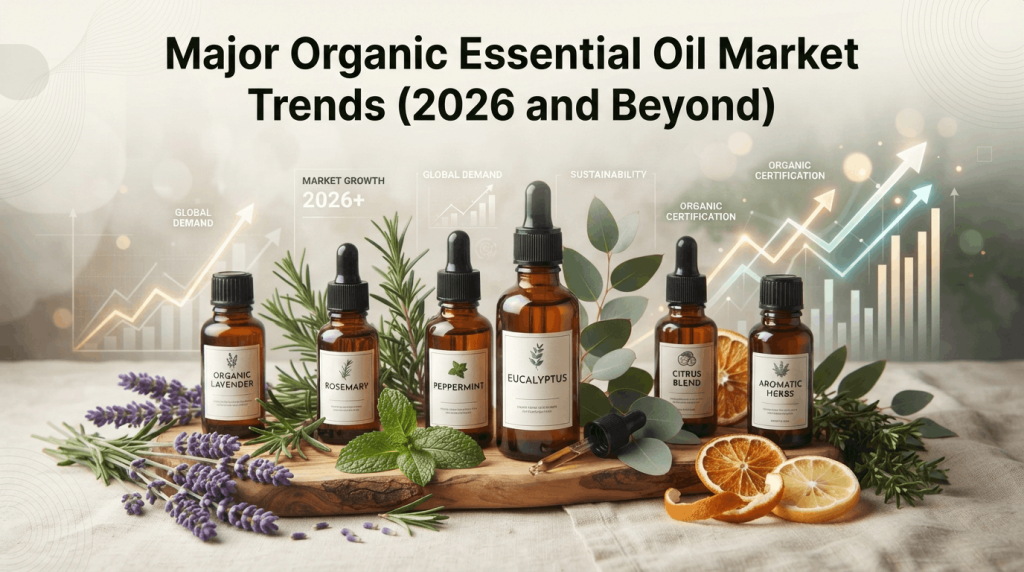
The demand for organic and natural products has been increasing year by year.
This is the crux of the whole trend. Customers all over the world, including India, USA and Germany, are asking, “Is this made naturally? When brands can confidently answer “yes,” they’re gaining customer trust and loyalty.
Let’s check out all the largest trends in organic essential oil market business.
- Sustainable Sourcing and Eco-Friendly Packaging
Sustainable sourcing is the procurement of plant materials without causing harm to the planet or depleting natural resources. Agriculture is becoming more water efficient, soil is being conserved and harmful chemicals are being avoided.
Meanwhile, businesses are also going green with packaging by replacing traditional plastic bottle. The replacements are recycled glass, biodegradable paper, and plant-based plastics.
This reduces waste and pollution, and customers are especially impressed by brands that are environmentally conscious.
- Growth into Wellness and Cosmetics Markets
Essential oils are no longer just for aromatherapy. They’re appearing in:
- Anti-aging skin creams
- Hair growth oils and shampoos
- Natural perfumes
- Bath bombs and soaps
- Massage and spa products.
This trend into wellness and beauty is one of the largest drivers of market growth.
- The rise of E-Commerce and Direct to Consumer sales
As already stated, it is the new normal to purchase organic essential oils online. Small and big brands can connect with customers around the globe. They do not have to open a store on every corner, thanks to websites, apps and social media.
- Adoption in Healthcare and Therapeutic Applications
Essential oils are slowly being incorporated in patient care by hospitals, clinics and wellness centers. They act as a complement to conventional medicine. However, oner should remember that it is not a replacement medications. Organic essential oils are for relaxation, pain relief and comfort.
- Regional Market Growth (Asia-Pacific, North America, Europe)
Asia-Pacific (countries such as India, China and Japan) is the fastest growing region. This is because there is an increased production of raw materials in these places. These include mint and citrus, a growth of incomes and an increased awareness of natural wellness.
The demand is high in North America due to the existing trust. ANother reason for demand is the usage of natural cosmetics and wellness products among the people of the region.
Europe is one of the largest markets due to the fact that they have a long history in aromatherapy. But, they have strict quality rules and enjoy natural perfumes and skin care products.
- Regulatory Developments and Certification Standards
The government and trade organisations are developing more explicit definitions of the meaning of ‘organic’. Certifications such as organic seals provide consumers with confidence that a product is truly chemical-free.
Also, new regulations are being established regarding the safety limits for some of the oil components. These rules are added to cosmetics, forcing companies to produce purer and better-tested cosmetic products.
- Development of new extraction and formulation processes
Businesses are developing more efficient methods of extracting oil from plants. One cool technique is referred to as CO2 extraction. Here, carbon dioxide gas is utilized rather than heat or chemicals. It retains more of the natural goodness within the oil.
AI (Artificial Intelligence) is also being used to test oils for purity. AI also helps to dentify fake or adulterated oils at a faster rate than ever before.
Rise or organic essential oils in personal care and household products
In addition to skincare, some essential oils such as lemon and tea tree are now widely used in:
- Natural cleaning sprays
- Laundry detergents
- Hand soaps
- Room fresheners
They’re used by people because they’re easy to clean, don’t have strong chemical odors, and smell good.
Aromatherapy and Functional Fragrance tailored to the individual
Personalized aromatherapy is a new trend in the organic essential oil market 2026. Herein customers can choose their own unique blends of oils according to their mood or needs.
In addition, there’s a new movement called functional fragrance. This concept is based on scientific research into the effects of fragrance on the brain. It is created specifically to help people with sleep or stress issues.
Organic Essential Oil Market Segmentation
Market segmentation simply involves dividing the large market into smaller market segments that are easier to comprehend.
By Product Type
- Lavender Oil – used for relaxation and sleep
- Peppermint Oil – digestive and cooling.
- Tea Tree Oil is a germ and acne fighting oil.
- Orange Oil – widely used in food, cleaning and mood enhancement products
- Lemon Oil – applied in natural cleaning and skin lightening products.
- Eucalyptus Oil – used for breathing and cold relief.
- Rosemary Oil – for hair growth and concentration.
- Frankincense Oil is a high-quality oil that is used in luxury skin care.
By Extraction Method
- Steam Distillation – most common method; uses steam to extract oil from plants.
- Cold Press – Extraction of oil by pressing, typically of citrus oils, without heat.
- Chemical Free CO2 Extraction – the modern method to ensure extra pure oils.
- Solvent Extraction – for flowers that are too fragile to be pressed or heated
The difference between organic and conventional food is one of nature.
- Organic – no synthetic chemicals used; limited availability, more expensive, rapid growth
- Conventional – produced using standard agricultural practices; more available, cheaper, consistent demand
By Application
- Cosmetics & Personal Care – soaps, lotions, shampoos, perfumes
- Food & Beverages – natural flavoring and preservation
- Consumer Products – pain relief creams, respiratory products
- Aromatherapy & Spa – diffusers, massage oils, relaxation products
- Household – cleaning products, air fresheners
- In the agriculture sector, natural pest control (Bio-pesticides) is used.
By Distribution Channel
- Online (E-Commerce) – Websites, Apps, Online marketplaces
- Online (Retail Stores) – supermarkets, pharmacies, specialty wellness shops
- B2B (Business-to-Business) – bulk sales to cosmetic, food and pharma companies
- Wholesale – sale of large quantities to distributors
Regional Market Analysis: Where is the Growth of Organic Essential Oils?
North America
The market is well established and is strong in North America. The people here already believe in natural cosmetics. Also, there is a good infrastructure of importers, manufacturers, and sellers, particularly in the United States.
In fact, the U.S. is one of the world’s largest importers and exporters of essential oils.
Europe
Europe boasts one of the world’s largest essential oil markets. It has a long history of perfumes – hello France! – and quality and safety standards.
There is a high demand for organic and clean label wellness products in countries such as Germany, France and the UK.
Asia-Pacific
This is the fastest growing area. India and China are significant producers of raw materials. Ffor example, India is one of the largest sources of mint and spice oils.
China is a huge producer of eucalyptus oil. Local demand is also rapidly increasing due to rising incomes and increased interest in wellness.
Latin America
Brazil is a world leader in citrus oils such as orange oil, and Latin America in general. The cosmetics, food and wellness industries are contributing to growth here.
Middle East & Africa
This space is shrinking but is still expanding due to increases in urban population. Therefore, an increasing number of stores offering health and wellness products and an increased awareness of natural personal care.
High Demand Organic Essential Oils Around The World
The demand for essential oils is growing year on year. However, the most demanded and viral essential oils currently are lavender, orange and peppermint. These essential oils are demanded worldwide for their versatile benefits and uses across industries.
All of these essential oils pack refreshing fragrance, multiple uses, skincare benefits and aromatherapy uses. Here’s an overview of the global market of popular essential oils and their demand.
Trend of Popular Organic Essential Oils & Their Demand
| Essential Oil | Benefits of Oils | Worldwide Demand | Top Market |
| Peppermint | Cooling, Digestive Aid, Reduces Pain | Demand Higher than other oils | North America |
| Tea Tree | Anti-bacterial and anti-fungal | High demand | Asia, Pacific Region |
| Rosemary | Mental Clarity, Hair Growth Benefits | High demand | Regions fo Europe |
| Lemon | Refereshing, Skin lightening and brightening | High demand | Regions of Europe |
| Orange | Boosts mood, energy levels | Demand Higher than other oils | North America |
| Lavender | Stress Relief, skincare uses, relaxing treatment, aromatherapy | Demand Higher than other oils | North America |
| Eucalyptus | Cough relief, respiratory aid | High demand | Pacific and Asia |
Organic Essential Oil Industry – Current Challenges
Every industry has its own challenges, and this one is no exception.
Climate Change
There are chances of crop failures such as lavender, mint, and roses. This happens due to unusual weather conditions such as droughts and floods. It can make it difficult to obtain sufficient raw material.
Fake and diluted products
Some oils are watered down or mixed with low quality chemicals that are then marketed as “pure” or “organic. This is bad for customers and fair businesses.
That’s why it’s important to do lab testing. A method called GC-MS testing, is required which tests the exact chemical composition of an oil.
Raw Material Shortages
Organic plants may take longer to grow or produce less. So, they may not be available in the same quantity, since they cannot use fast-acting chemical fertilizers.
Price Fluctuations
Weather, crop size, and shipping costs can all cause essential oil prices to fluctuate. This makes it difficult for companies to make predictions about the future.
Strict Government Regulations
Labeling, safety limits and organic certification rules differ from country to country. This also creates complications and makes it expensive for companies exporting their products internationally.
Opportunities for Investments in the Organic Essential Oil Market
There are some positive signs for investors or businesses in the organic essential oil market:
- Organic Farming – Cultivation of aromatic plants without the use of pesticides for higher prices.
- Export Business – Raw or processed oils to cosmetic and pharma companies overseas.
- E-Commerce Brands – Creating e-commerce stores directly to consumers.
- Private Label & Contract Manufacturing – Supporting new wellness brands with quick product launches
- Green Extraction Technology – Investing in cleaner and more efficient extraction methods.
- Emerging Markets – Access to the fast-growing markets of Asia-Pacific and Latin America
Future Outlook: Organic Essential Oil Market from 2026 to 2035
In the future, the organic essential oil market is projected to continue expanding at a steady pace. It is potentially growing to USD 30 billion to USD 66 billion by 2033–2035, and with a CAGR of 9% to 11.8% on average.
What is to come:
- As more organic certifications are introduced across the globe, it will be easier for consumers to trust labels.
- Oils will be purer and safer with new extraction technology such as CO2 extraction and AI quality testing.
- The use of sustainable and eco-friendly packaging will no longer be a rarity, but the norm.
- Asia-Pacific will continue to be the fastest-growing region, with the growth of farming and the increasing demand for wellness.
- Brands of organic essential oils will continue to sell online, as will all other product lines. All other product lines will continue to be sold online as will essential oil brands.
- Custom wellness products like personalized oils will gain in popularity
- The industry is generally strong, resilient and promising for farmers, manufacturers and consumers.
You may also like this:
- Essential Oil Packaging Guide For Startups
- How To Start an Essential Oil Business in India – Step by Step Guide
FAQs
1. What is the Organic Essential Oil Market?
The Organic Essential Oil Market is the worldwide business of cultivating, manufacturing and trading plant-based essential oils. The essential oils that are free from synthetic chemicals and pesticides.
It encompasses the farmers, the oil producers, and the brands that sell the oils to consumers.
2. What will be the growth rate of the organic essential oil market in 2026?
The overall essential oil market (including organic oils) is estimated at USD 13 to 31 billion in 2026. This depends on the research source, and is projected to continue to grow steadily until 2035.
3. What is the growth rate (CAGR) of the essential oil market?
The majority of industry reports suggest that the market will expand at a robust pace of approximately 9% to 11.8% from 2026 to 2035.
4. What is making essential oils so popular?
Individuals are looking for natural, chemical-free products for their skin, hair, food and homes. Essential oils are also used for relaxation, aromatherapy and even natural cleaning, making them helpful in many aspects of life.
5. What is the fastest growing region in the essential oil market?
The region of Asia-Pacific is the fastest-growing region, owing to the increasing cultivation of aromatic crops. Other factors are increase in income levels and the interest in natural wellness in countries such as India and China.
6. What are the difference between organic and conventional essential oils?
Organic essential oils are derived from plants that are cultivated without synthetic chemicals or fertilizers. However, conventional essential oils are extracted from plants that are regularly cultivated.
Organic oils tend to be more expensive but are believed to be cleaner and more environmentally friendly.
7. What are essential oils mainly used for?
Essential oils are used for many purposes. Ther are used for making the home smell good to soothing and calming, for skin and hair care. It is also added in natural cleaning sprays, and even as a natural flavoring in food and drinks.
8. Which essential oil is in demand worldwide?
Orange oil is one of the most popular essential oils, which is used in food, drinks, cleaning products and aromatherapy. Another popular scent is lavender and peppermint, which is very popular all over the world.